The Vanishing Twin Syndrome, and the traumatic reality from this loss.
This is the article I wrote that has now been published in
Untwinned: Perspectives on the death of a twin before birth,
ed. Althea Hayton, St Albans, 2007.
ISBN 0-9525654-9-8.
For the past twenty-five years doctors have been aware that in twin pregnancies one can die in the womb. In the medical profession it is referred to it as the Vanishing Twin Syndrome (Vts). When reading the many reports and papers that discuss this matter, only the mother or the newly born baby are referred to. Doctors are, quite naturally, concerned that the presence of dead tissue in the womb may affect the health of either mother or infant.
This matter has only recently been addressed in therapy. When we produced our reports in mid-2005 I searched the web and the university periodical indexes for information, but could find nothing on the impact of inter-uterine death on the adult life of the living twin. It was as if the baby brought nothing from the womb but its body - and therefore anything else could be left out of the picture.
I am a director of the Crucible Valley Centre, an institute that teaches Transpersonal Psychology in New South Wales, Australia. Our approach is experiential, and includes deep personal therapy with all students. We have been finding through them that the ‘disappearance’ of a pre-natal twin was often having a profound impact on the whole of later life of the living twin. This was not in a few isolated cases, but in hundreds of clients. It was a possibility my teacher Eila Carisbrook had mentioned almost twenty years ago and that I discussed in my 1994 book, Notes to Transformation.
It was not until the issue kept on turning up that we realised how enormous it was – both in numbers and impact.
With my wife Hilary and our partner Marg Garvan we gradually became more open to the possibility that such a death could affect the deepest psychic structures of our clients. We have now worked with more than fifty Vts situations and, based on its occurrence among our clients, we estimate it affects more than 25 percent of all conceptions. However, this proportion of one-in-four may not be reflected in the general population. It may be that the buried grief from the loss of a twin companion may induce more people to seek therapy than others. This would reduce the apparent proportion.
How do we know when someone has lost a twin in the womb? One of our modalities is sandplay. It is a technique that will often show our needs and feelings very clearly. In the sandplay room there are a thousand small objects on shelves around the room. You place them in a tray filled with sand. We help the client discover the message from the unconscious contained in the arrangement. This invariably tells you exactly what is going on in the hidden parts of yourself.
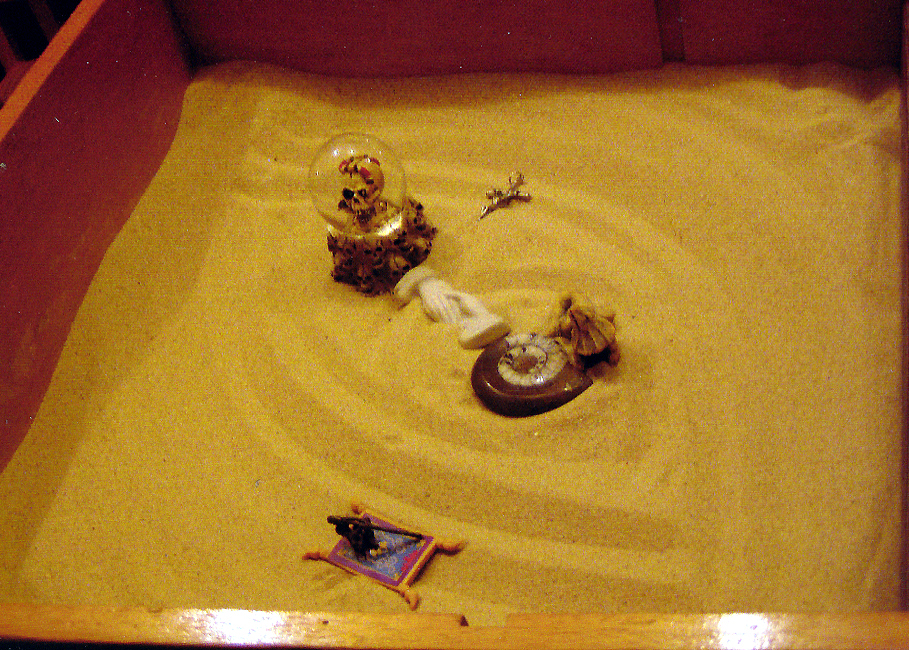 Fred is a steady worker, yet without much sense of achievement. He is constantly searching for a woman, but cannot form intimate or lasting bonds. Fred is a steady worker, yet without much sense of achievement. He is constantly searching for a woman, but cannot form intimate or lasting bonds.
In the tray he created a diagonal axis with an almond-shaped mandorla marked in the sand. Along this axis he placed in the middle a glass ball enclosing a skull; a fossil on the right, and between them clasped hands. A little goanna was placed on the fossil, which he described as having the feeling of “soft and uncertain longing.” The cross points to the skull.
In the session he remembered that he had been told he had had a girl-twin that had died well before his birth. The session deepened when he identified with the goanna and the fossil, and himself helplessly holding on to the departed sister. He felt he was like a "dead fossil" without her. His inner ‘centre’ lay in the white hands, clasping onto the female who had gone.
As therapists, we had to drop our own agenda and adapt to the client's truth. The feelings he was experiencing were so profound that we knew it was not just a story, but something that was deeply embedded in Fred's psyche. We were convinced by the emotional coherence of his experiences, not by anything else.
In the sandplay the objects used and their symbolic significance made the meaning pretty clear.
Yet we puzzled for a long time on how was it possible for a foetus, often barely more than a few weeks old, to have feelings in response to an event in the womb, and continue to bear those feelings into adulthood. In the first trimester when most twins die the foetus has a spinal chord but the brain is still miniscule. Yet our clients were describing memories and feelings recalled from the first trimester of life with absolute clarity.
We began to notice that more than emotional memories were involved. There seemed to be another factor that we could not relate to the simple reactions we would expect to find at the foetal level. There were clear indications from our client's work in the sandtray and in energetic processing that the remaining twin was responding to the death in ways that could only be called intelligent. It was if the foetus was being presented with choices, and swung towards one or the other with such determination that it affected the whole of later life. It was a process that could only be called 'decision-making'. This is an adult concept, yet there has been no other way to describe the clinical evidence.
We are taught that it is not until the infant is born that mind and feelings respond to the environment. We are told that at birth the baby has an 'unformed' mind and is still a tabula rasa, an empty slate. It became obvious that this cannot be true. It is evident now, after so many years as therapists working every day with early experiences and traumas, that this is nonsense.
We have concluded that losing a twin is one of the most powerful events occurring in the womb. It takes place so early in the creation of the foetus that any response is set into the later physical and emotional development of the baby. The foetus has feelings and its development is affected emotionally by these events. The sad thing is that the origin of the grief that is carried from the loss is almost impossible to detect in normal therapy.
This opens one great question that so many people have around the Vts: "In the early months the foetus does not have the physical capacity to hear or see, let alone sense or remember experiences beyond the placenta, so who remembers?"
Who remembers, indeed! Jenny Wade and David Chamberlain are two among many who have published widely on verifiable adult memories of experiences in the womb. These are so precise that we have to conclude that there is a witnessing medium capable of sensing and remembering during parturition. This 'witness' is present in, or in the vicinity of the foetus and the mother all through pregnancy. It seems to be related in some way to the Higher Self, or perhaps the soul.
Using this concept with our clients during therapy is the most effective way to create a healing ambience. We refer to the one who senses and remembers as their true Self, and that the loss in the womb is an arrangement made between Selves.
Let us now discuss what is it in a clients' behaviour that may indicate the presence of a Vts? For more information refer to The Crucible Centre where we help resolve the issues that come from being a survivor.
By adulthood the impact has usually become quite subtle and is less focussed than more recent traumas from childhood. Among many 'symptoms' the most important is that they never understand why they should be constantly plagued by feelings that have no apparent cause. They find it really hard not to know what is driving them all the time. They feel different from others, and very alone. Some of the symptoms are contradictory, and typical of what psychologists would call separation anxiety.
The list is at the end of this article.
Some symptoms, you will notice, are relatively minor. My wife Hilary had lost a twin, and has since childhood been very interested in death experiences, and also fascinated in twins. Yet these absorptions were fairly relaxed and detached. She has been strongly influenced in her life by this event, but not traumatised. She was lucky in this, for her case is not typical. What sets a Vts apart from others is that even where there has been little suffering in childhood they still have feelings of loneliness and abandonment.
In our work we find that the first level of healing comes once the cause is understood. Here are three typical people who got enormous benefit from realising their history. Sarah would bring all her relationships to a quick end because, though she could not have told herself why, she could not bear the fear they would abandon her if they got too close. Mary had anorexia that turned out to be linked to her foetal guilt that when her twin had died, Mary decided it was because she had 'stolen' all the food. Bill had spent a lifetime searching for a twin-soul to merge with until he discovered he had had a twin of the opposite sex, and this helped to explain why he had passionately longed to be a girl and had thought of becoming a transvestite.
One of the modalities we have developed at the Crucible Valley Centre is called energetic processing. In it we use connected breathing in a very quiet setting to support the client to move into the deeper spaces of the psyche. It is a soft process, yet is able to access the most profound issues that have become embedded in the psyche from foetal times. Combined with sandplay, this work has brought many of these decisions to consciousness. Here are some typical ones, and in brackets the more common consequences:
- I took all the nourishment and he starved [bulimia, anorexia]
- I was responsible [remorse, acting out war stories, self-punishment]
- I failed because I could not keep him with me [self-blame]
- I feel poisoned [becomes vegetarian, hypochondriac]
- I blame myself for his death [deep distrust, self-loathing]
- I was not worthy, so I had to remain on earth [unworthiness]
- I will be on a spiritual path so I can follow him [fantasy, ungrounded]
- Why did I live and my companion die [guilt]
- I wont leave him [wont grow up, retreats under stress]
These are all common decisions people make in response to events in growing up, and are not necessarily created through the loss of a twin. It is only in an actual clinical situation with the energetic support of the therapist that the client is able to self-examine deeply enough to work out whether the decision came from the womb.
It is important to realise that in therapy the client's view of themselves is primary. We therapists listen and respond. Were we not to be, in this sense, the passive receiver of a client's truth the client would seldom have the energetic support needed to discover themselves. It is not easy to communicate this concept in a short article, but it lies at the core of effective transpersonal psychology.
How can we be sure that we are not dealing with pure fantasy? How do we know that the self-investigation is not a delusion? There is a 'ring' to the truth, an emotional wholeness that is hard to gainsay. Without writing a book on 'knowing' I will give the outcomes of these cases in their own words:
I have spent fifty years not being able to feel my body. It was something that hung off me, and not in me, if you know the difference. I had already traced that feeling to an operation I had when I was four to remove a second bowel that was strangling my working bowel. In therapy I felt into the place where that bowel had been. It was a huge surprise to recognise that the extra bowel had been full of a happy, joyful energy, and that when it was removed, that vitality went too. I concentrated on drawing it back to me and had a sensation of wiggling fingers and toes, but it was coming from the second bowel. It seemed that that second bowel came from my dead twin. I felt so different afterwards - very different about everything I touched.
In the second case, a series of unconnected memories formed a coherent pattern for the first time when she realised what was driving her sense of abandonment:
I am struggling with allowing this to be the truth. It seems too incredible and yet it felt incredibly real. Such huge choices being made between my foetus and another. It presents an unknown which is very scary. I want it and I am afraid. Yet it does resonate with who I am. I have a very powerful memory of the night I was taken to hospital when I was five and watching my little brother in a car going in the opposite direction as he went to stay with our grandparents. Watching him go - losing him. The clarity and strength of the feelings - like losing a part of me - again. I had the same experience when my first child was born. I feared he might leave me, and only when he cried did I realise how tightly I was holding on to him! Endlessly holding on from fear.
The third case is the very typical response that we are being 'acted' on by feelings and impulses over which we have neither control nor understanding. This man had no purpose in life, and needed others to make decisions for him. He would often panic in large spaces and would suddenly feel he did not know where he was going. When this happened he was unable to retrace his steps in order to find out where he had been.
I have spent my life continuously drifting, while waiting for someone to come back and rescue me, take me away. I've always felt as though I "missed the boat". I can now see that I have been manifesting this 'decision' in my life. It is a pattern that keeps repeating itself. No longer is there any blame on myself – or on others. It feels as though the decision, now it is exposed, can be dissolved and transformed.
The most effective healing procedure, we find, has three steps. It is to remember by accessing buried and sensitive inter-uterine feelings, to recognise them and then to forgive the other for leaving.
However, we find that just having knowledge of the event is not enough to really clear the matter. It is finding the exact and very subtle tone of the embryonic response, and defining this exactly in words so it contains the flavour of the moment. Where it involves a decision, the precise terms of that 'agreement' need to be spelt out. As this is becoming clear we need to sense the full catastrophe in the cells of the body.
In a typical case Gail allowed her body's memory to guide her in the physical movement she had made away from the body of the dead twin, and as her consciousness sank into the movement the nature of her response to that trauma grew and became lucid. Her adult witness could then interpret that movement in precise words. The wording that describes the response then becomes vitally important in the healing process. Afterwards as we absorb the reality of what has happened and can conceptualise the response as a decision, then we are able to follow how it surfaced in a myriad events in life. It is then that we become free of the trauma – but we never forget.
For some people a crucial part of the healing comes in how we relate to the residual guilt, or even a shame that seems to have no source. We may have had a wonderful childhood with loving parents, yet still feel a disquiet that we blame ourselves for. The answer lies in a process of forgiveness, but it is not enough to say the words or to hold some repeated affirmation. Forgiveness needs to come from the heart – truly. Gail wrote
I have felt that I needed to offer something to my dead twin, but felt inadequate as there was nothing I could offer that would be great enough. I had felt this at the time, as then I lacked so much substance. I have come to recognise that offering my forgiveness was the most vital part of the process. Then an amazing sense of freedom rushed though me, and I was able – that was the magic, actually 'being able' – to forgive myself for not being conscious about this all for so long.
Sometimes these decisions can be complex. In this example one twin intended to leave, and instead made an arrangement with the other. This is unusual, but shows the power of the psychic 'decisions' that may be made and the long-lasting distortions it leaves behind:
I think I am a practical man, but really I'm not. I discovered two things from regression, that I had had a twin, and that this twin was the practical one while I was essentially a dreamer. I was staggered to realise that while my twin was dying in the womb I had offered to take over the practical role just to stop him leaving. Now I know why things don’t work for me: it is these contradictory drives! The dreamer in me screws up the practical, while the practical undermines my dreams. That's tough.
Consider that George had two women in his life. The first was a practical down-to-earth person, while the second was dreamy and impractical. The first longed to help people while the second needed to be helped. One client wrote that
It felt archetypal – that he would sacrifice his life in order to 'kick start' my journey. My closest friend died when I was 25, and at his funeral it was said that his life's purpose had been to die for many others, in the support of their journey. It cracked me up when I heard this – it felt so true for me, personally.
Conversely many carry a fascination with death. The may be especially in those cases where the dead foetus remained for a time in the womb before being absorbed. Gail had written
All my life I had put death on a pedestal, as all the 'special' people in my life had died. I had the belief that one must be pretty special to die. It was one of the ideas I used to beat myself up with, as I thought to myself that as something "was too special, I would never be able to match that".
Sometimes the attachment to the womb-experience can have a baleful influence over a much wider field. Jean had run many large organisations, but always found that a considerable opposition would invariably develop against her, and she had to move on. It was often made worse because she would usually have developed a special friendship with just one person. Jean knew she had had a twin, and in a later process recognised that when her twin had died she had decided that her environment was dangerous, even toxic. She reflected this belief onto her work, and when she had found her 'twin' in her special friend would project the trauma by unconsciously turning her work environment into a dangerous place for both of them. Within minutes of leaving after this discovery Jean's friend rang her, anxiously demanding they have coffee together. Such an intimate connection with a surrogate twin is far from uncommon.
Intimacy can go much further than this. Sally had lost a twin, but her daughter had not. The daughter came to us when 12 as she was still sleeping in mother's bed, refusing to leave home for school and starting to wear her mother's clothes. She produced this extraordinary drawing of her family, with herself within the womb-space of her mother.
When Sally's twin had died thirty-five years earlier her response was to go seeking him. This led her in later to look for the perfect match in all her friendships, and married a man who (though not like her in personality) looked her exact double. Her terror of dying and frequent panic attacks only added to the intensity of her search, and the constant fear that the search would inevitably fail.
When her daughter was born there was an instant bonding. It seemed that the natures of their two Higher Selves were in close resonance. Whatever the reason, the bonding gave Sally the sense that she had at last found her lost twin.
She described the therapy as being "enlightening, and excruciatingly wonderful", and in the days that followed her daughter moved into her own room, and began to buy very feminine clothes just for herself. The healing has continued so that now both are comfortable with themselves, and the intensity of the initial bonding has faded away. Bringing a self-aware consciousness to a precise understanding of the event brought about the healing.
What we have learned from all these clients is that there is no straightforward or simple outcome to losing a twin, but that the consequences are unique to ever individual who has to search into their own womb-history to discover the truth. It is then the precise definition of this truth that sets them free.
Presenting Symptoms
* Ineffable but profound sense of loss, loneliness, abandonment
* Will act out against others neurotically, or against themselves masochistically
* Deep unarticulated fear that loss will happen again, a pervasive insecurity
* Hard to trust, which diminishes the ability to bond except in a neurotic way
* Sense that others will not support them or endlessly wanting to support others
* Longing that cannot be fulfilled
* Belief that some part of them is missing
* Deep shock that holds back maturity so they remain childish
* Needing to be physically near others, often sleeping wrapped in the other's arms
* Yearning for the perfect partner, often resulting in co-dependency
* Sense that some one, or some guardian angel is caring for them
* Stretching towards others so they merge easily, often with imaginary friends
* Being extremely sensitive to the needs of others
* Loose or over-strong personal boundaries,
* Resentful at having to suffer their own birth alone
* Fear of or fascination with death
* Understanding of death that appears innate
* Split so always looking outside themselves for their identity
* Courageous, for they have to do it alone
* Avoiding public display, physical contact or being looked at
* Fascination in twins, watching them on TV or dreaming about them
Two among dozens of references: L. Sulak, M. Dodson, “The vanishing twin: pathologic confirmation of an ultrasonographic phenomenon”, The American Journal of Obstetrics and Gynaecology, 1986, lxviii: 811-15; H. Landy, L. Keith, “The vanishing twin: a review”, Journal of Human Reproduction (Update), 1998, iv, 177-83.
John James, Notes to Transformation, Leura, 1994, available on the web.
There are many books on sandplay. If you are interested I suggest you read Ruth Ammann, Healing and Transformation in Sandplay, 1991, Illinois and Estelle Weinrib, Image of the Self: The Sandplay Therapy Process, 1983, Massachusetts.
Among many: Jenny Wade, “Physically transcendent awareness: A comparison of the phenomenology of consciousness before birth and after death”, Journal of Near-Death Studies, xvi, 1998, 249-275; David Chamberlain, “Are telepathy, clairvoyance and ‘hearing’ possible in utero? Suggestive evidence as revealed during hypnotic age-regression studies in prenatal memory”, Pre- and Peri-natal Psychology Association of North America, vii 1992, 125-137.
|